
Recorded Instruments in Loudoun County
The Loudoun County Clerk of the Circuit Court keeps the county's land records. Its published catalog covers deeds, deeds of trust, assignments, certificates of satisfaction, judgments, and subdivision plats. Every instrument plays its own part in the paper trail. A deed records a conveyance. A deed of trust records a secured loan. An assignment moves an interest from one party to another, and a certificate of satisfaction shows that a debt was released.
| Deed Type | What It Does | Common Use |
|---|---|---|
| Conveyance deed | Records a transfer of an interest in land | Compare parties, legal description, and recording reference |
| Deed of trust | Records a security interest tied to a loan | Look for a later assignment or satisfaction |
| Assignment | Transfers a recorded interest from one party to another | Follow the instrument reference in the Clerk index |
| Certificate of satisfaction | Records release of a satisfied debt | Match it to the deed of trust |
| Subdivision plat | Shows recorded lot and subdivision geometry | Check the plat reference cited by a deed |
A deed and a loan instrument often sit in the same chain of title. Yet they answer different questions. The deed tells you who conveyed or received an interest. A deed of trust, assignment, or release deals with an encumbrance instead. Pull the most recent deed for the parcel first. Then work through related instruments by party name, document type, and recording reference.
Open the Loudoun County Land-Record Index
The Clerk's Public Access system is the remote name index for Loudoun County deed records. Basic indexing is free after account registration. Document images cost extra as a separate purchase. Search by the current grantee or a likely parcel owner. Then confirm each result through its legal description and recording date. The county itself warns that the index is only a guide. It also tells researchers to try spelling variants. Older name forms often hide in plain sight.
The public entry screen displays the Clerk's search access path. It also links to Loudoun land records.
Open the Loudoun County Public Access land-record portal before searching. That page is the entry point to the Clerk's index and the remote image service.
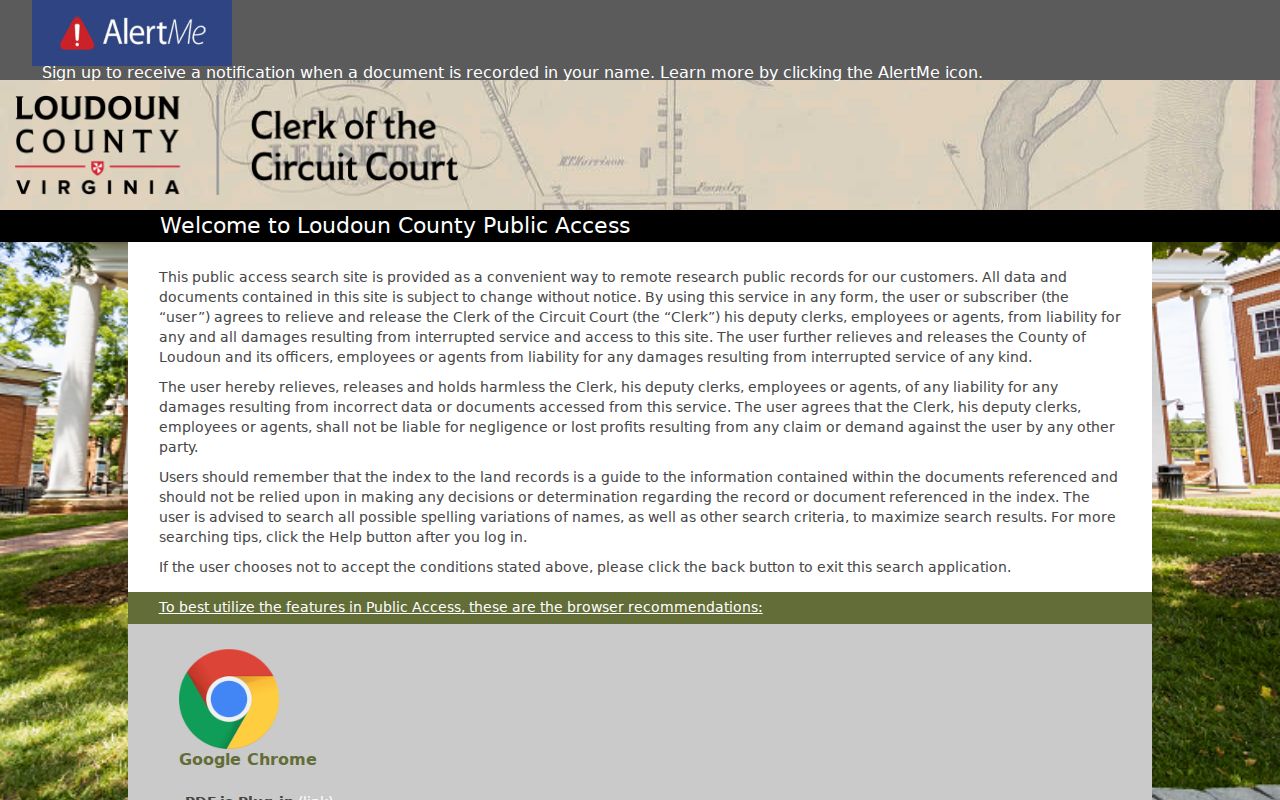
A result is only a lead to an instrument, never proof that every related document is in hand. Check names, parcel description, and dates against the assessment card.
Walk the Loudoun County Grantor-Grantee Trail
A grantor conveys the interest and a grantee receives it. Tracing an ordinary deed chain starts with the current grantee, then uses the prior grantor named in that document as the next grantee in the earlier transfer. Never pick a deed by name alone. At each step, confirm the legal description, the parcel, the book/page or instrument reference, and the recording date.
- Find the newest deed that fits the parcel and note its grantee, grantor, legal description, and reference.
- Search the grantor as a prior grantee to locate the deed by which that party acquired the land.
- Repeat with the earlier grantor, checking name order, initials, spelling variants, and the parcel description.
- When the index period ends, move to the historic index PDFs or deed books rather than treating a missing result as the end of the chain.
- Grantor
- The party transferring an interest in the recorded instrument.
- Grantee
- The party receiving the interest.
- Chain of title
- The linked sequence of recorded conveyances for a parcel.
- Index reference
- The book/page or instrument pointer used to locate the document image or copy.
Loudoun County Historic Deed Index Years
Loudoun County groups its historic deed index PDFs into six spans on the county's historic deeds page: 1757-1812, 1813-1833, 1833-1857, 1857-1878, 1878-1893, and 1893-1903. The Clerk dates land-record research back to 1757. Not every image from that first year appears in the remote viewer, though. A separate finding aid pulls those periods together and links to related record resources. Use the Loudoun County historic deed-index PDFs to pin down a reference. Then request or pull a book.
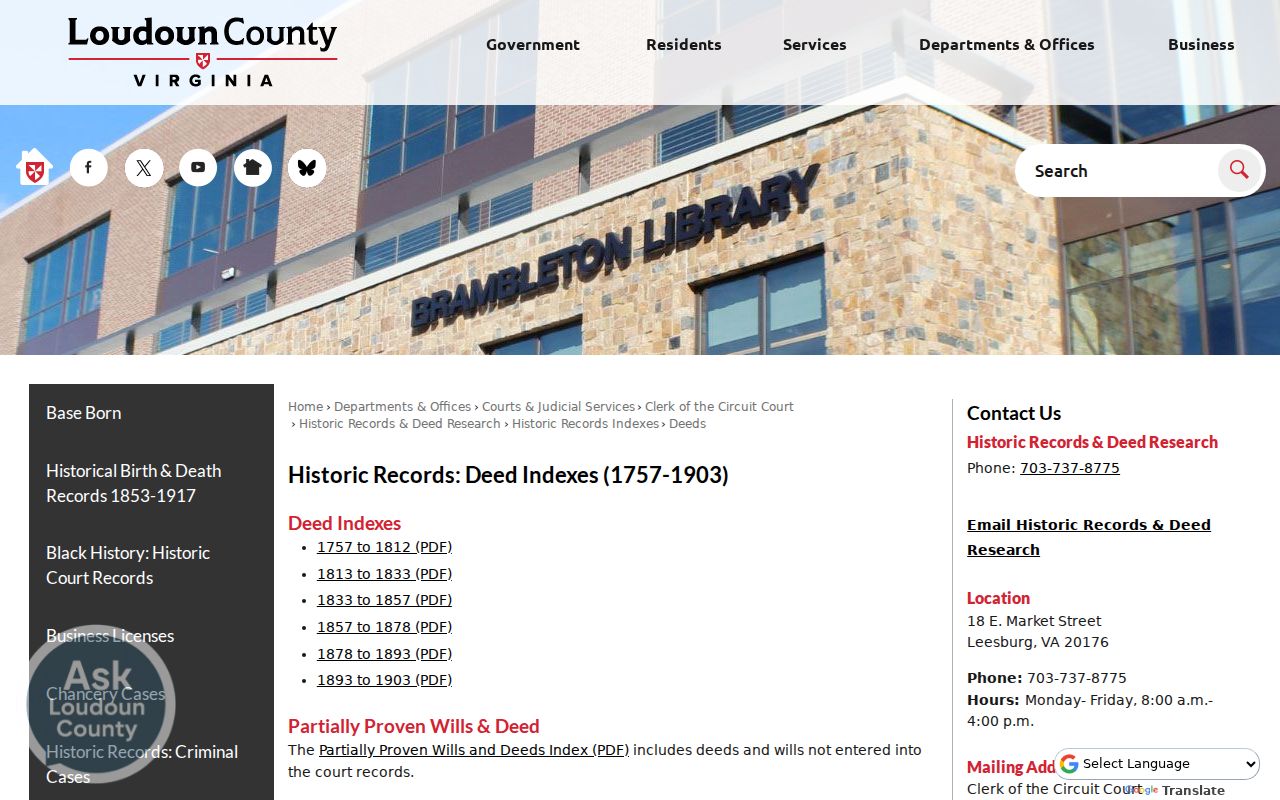
Loudoun County's historic deed index lists grantors, grantees, and dates. The deed book itself holds the recorded terms. A chain reaching across 1903 may require the index PDF plus counter research. The six PDF runs share boundary years. 1833 ends one span and opens the next. So does 1857. A deed date may sit close to one of those cutoffs in the Loudoun County property records. Open both files instead of trusting a single date filter.
Spelling can trip the index too. An older name form or a variant may hide the entry you need. Search both the grantor and grantee sides. Keep the instrument reference alongside the parcel's legal description for the deed records lookup.
Find Older Loudoun County Plat References
A plat is a recorded map. It lays out lots, streets, easements, and dedications. The Clerk's Plat Reference Index lists most plat references found in deed books. Coverage runs from 1757 through the middle of 1945. The county states plainly that the index is not all-inclusive. A blank result should lead to further deed-book inspection. Do this whenever the parcel history suggests a plat exists.
For a newer subdivision, tie the assessor PIN to the GIS subdivision layer. Then use the recorded plat to read lot and block calls, easements, and dedication notes. For rural land, hold onto the metes-and-bounds description, acreage, roads, streams, and adjoining-owner references. The current PIN may have changed after a division or consolidation.
Historic Records staff can help locate a reference and a page count. They do not perform legal research or interpret the instrument. A careful researcher brings a name, date range, parcel key, or earlier document reference. Bring it to the counter.
Match Loudoun County Deeds of Trust to Releases
Paying off a loan does not erase the deed of trust. The instrument stays in the Loudoun County land records. What clears it is a later certificate of satisfaction or release. Match that instrument to the original by parties and reference. The paper trail then makes sense. Assignments matter too. They explain why the secured party's name changed over the life of the loan. The Clerk groups deeds of trust, assignments, and certificates of satisfaction among its land-record categories.
Judgments and mechanic's-lien disputes can also attach to a parcel. A court docket helps you locate a case. But docket status is not the same as a recorded release. Check the deed records index for the operative instrument. Ask the Clerk for a certified copy when you need a formal version.
The assessment card may sketch sales or parcel history. It is not a lien search. Rely on the deed index for recorded interests. Use the Circuit Court case search for litigation status. Each record has its own custodian, and each its own scope.
Watch Loudoun County Recording Alerts
Loudoun County's Clerk offers AlertMe, a free notification service. Register a name, and you get an email. A new land record is recorded under it. The sign-up form asks for an email and confirmation, first and last name, a password, and optional phone and carrier details. Think of it as an early-warning tool for future filings. It is not an ownership search, and it never replaces reviewing the actual deed.
AlertMe shines when you want to monitor a name after a deed has been recorded. An owner worried about a suspicious filing gets a heads-up. Something has landed in the deed records. Suspected land-record fraud should go to the Sheriff immediately. Confirm any notice inside the official land-record system first. Then reach the Clerk or law enforcement through the county's official page.
The Loudoun County Clerk AlertMe page is the official starting point. Silence from the system means only that your selected notice rules triggered nothing. It does not certify clear title.
Get a Loudoun County Deed Copy
Loudoun County gives you three practical routes to a deed copy. The remote index lets you locate a document and purchase its image. A free public kiosk operates at 18 East Market Street on weekdays from 8 a.m. to 4 p.m. Or request paper copies by mail or at the counter. Address them to Clerk of the Circuit Court, Attn: Historic Records, P.O. Box 550, Leesburg, VA 20178.
The fees are straightforward. Paper copies run 50 cents per 8.5-by-11 or 8.5-by-14 page, and $1 per 11-by-17 page. Certification adds $2 per document. Remote images cost 50 cents per page. Convenience fees add the greater of $2 or 4 percent. Heavy users can opt for a $262 annual subscription. It unlocks unlimited index and image access once the application is approved.
The county posts the free kiosk and remote options side by side on its land-record access page. The same page walks through the paid image and subscription choices.
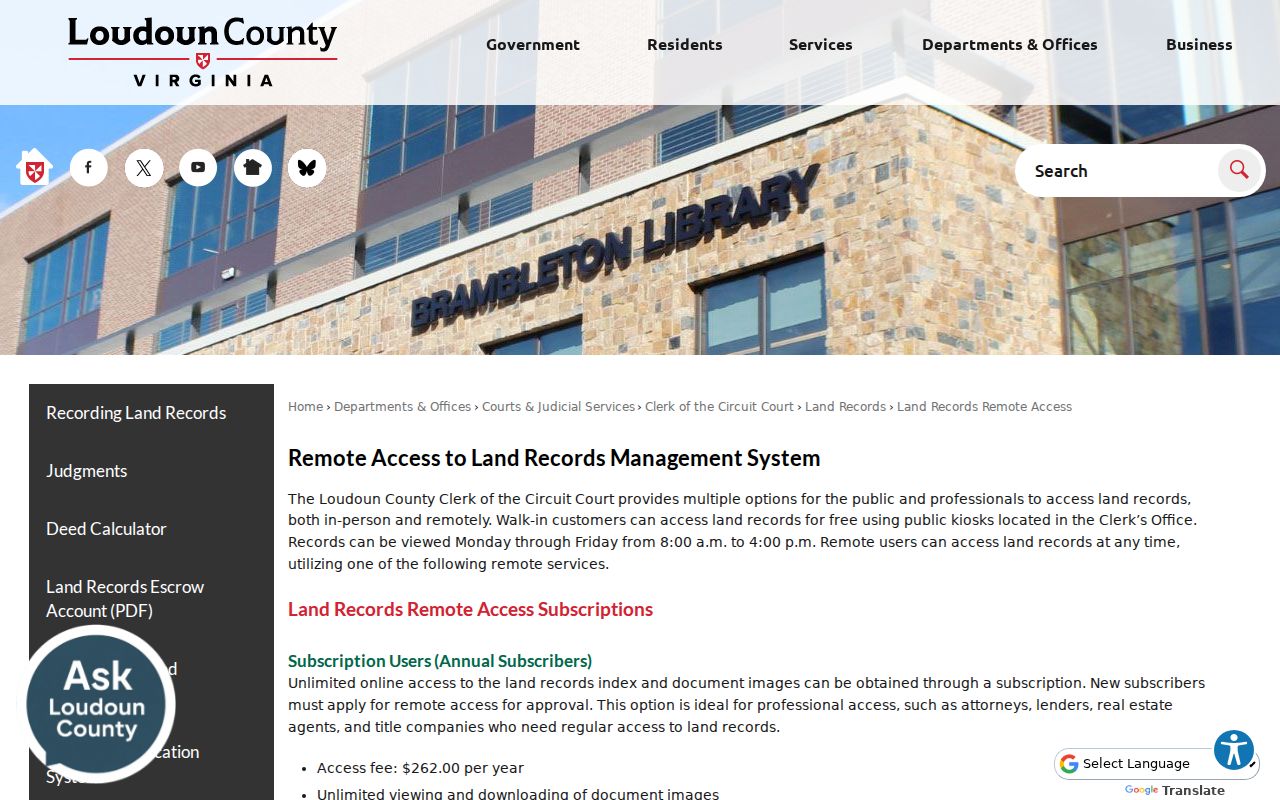
A deed copy request goes fastest when it is specific. Include the instrument reference, the page count, your preferred paper size, and whether you need certification. Those details let staff fill a defined order instead of guessing which record matters.
Recorded, not guaranteed. The Loudoun County deed index is a guide to recorded instruments, not a title opinion. Search name variants and confirm the legal description before relying on a result.