
Start a Loudoun County Property Search
The question picks the source. A street location points to the Real Property Search database first. Type a street number and part of the name. The system returns a PIN, owner, legal description, value, and sale information. Owner names work too. The assessor system will search them, though a common name needs a parcel or address check before it ties to one house.
Ownership history runs through the Clerk's Public Access land-record index. Tax balances sit with the Treasurer's account service. For parcel shape, open WebLogis. Each system describes one slice of the same property record, so compare the PIN and legal description as you move between them.
- Search the county assessor by house number and a short street name. Leave off words such as Road or Street if the first search misses.
- Save the PIN, tax-map number, owner field, situs address, mailing address, and legal description from the matching parcel card.
- Use the PIN or owner name in the Clerk’s land-record index, then check the newest deed and any linked plat.
- Open the parcel in WebLogis for nearby parcels, town lines, zoning, imagery, and other map layers.
- Use the Treasurer’s account or public tax reports for bills and payments. Ask the custodian for a copy when a record image is not online.
Which Loudoun County Offices Keep the Records
Loudoun County splits its land records across offices. Deeds, assessments, tax bills, and maps each have a keeper. Leesburg is the county seat. The Clerk's public counter sits at 18 East Market Street. Historic Records staff will help locate an instrument reference or page count. But they stop short of interpreting a deed or running legal research for you.
Loudoun County Circuit Court Clerk
18 East Market Street
Leesburg, VA 20176
Historic Records: 703-737-8775
Commissioner of the Revenue
1 Harrison Street SE
Leesburg, VA
Real-property assessment and ownership search
Loudoun County Treasurer
Tax bills, payment records, tax rates, and delinquent-sale information
703-777-0280
Loudoun County Deeds Reach Back to 1757
Loudoun land records run from 1757, by the Clerk's own account. Historic deed indexes sit in six date bands. The last ends with 1893 to 1903. Those indexes are finding aids, not proof that every old deed image waits in the remote system. An early owner search may need the deed book itself, a historic index PDF, or help from the Historic Records and Deed Research Division.
Long chains reward patience. Start with the parcel's current legal description and deed reference. Track grantors and grantees backward, checking spelling variants and initials at every transfer. Estates complicate things. A probate file may explain how the next deed was authorized. Older plats can supply lot geometry that a later deed only names.
Two more aids exist. The Clerk publishes a partially proven wills and deeds index for instruments never entered into court records, plus a plat-reference list covering most deed-book plats from 1757 through mid-1945. That plat list is expressly not all-inclusive. A missing entry is not proof that no plat exists.
Index Access and Deed Images Differ
Remote access splits the name index from the image. Basic indexing is free once you register. Images cost more. A remote page runs 50 cents plus a convenience fee of $2 or 4 percent, whichever is greater. An annual subscription costs $262 and, after application and approval, includes unlimited index and image viewing and downloads.
There is a cheaper route. A free public kiosk at 18 East Market Street is open weekdays from 8 a.m. to 4 p.m., useful when a researcher wants to inspect records without paying per remote page. Paper copies go by mail or Clerk's office pickup. A request should state the instrument reference, page count, paper size, and whether certification is needed.
The paper rates are modest. Copies run 50 cents per letter or legal page and $1 per 11-by-17 page. Certification adds $2 per document. These are copy charges, not legal research fees; staff will help identify a reference but do not decide what an instrument means.
Record Sets Behind a Loudoun County Property
One property can pull in deeds, assessments, tax payments, maps, permits, and court files. Pick the record that answers the question. Confirm key details in the source that controls them. An index can lead you to a document, but the document and its legal description carry the recorded terms.
| Record Type | What It Documents | Kept By | Access |
|---|---|---|---|
| Deeds and deeds of trust | Transfers, loans, assignments, and recorded releases | Circuit Court Clerk | Free index; paid remote images or free kiosk |
| Assessment roll | Owner, parcel, legal description, sales, value, and building traits | Commissioner of the Revenue | Free public search, updated weekly |
| Tax bills and payments | Amounts due, payment history, delinquency, and rates | Treasurer | Account portal and monthly public reports |
| Parcels and plats | Map context, subdivision lines, parcel IDs, and recorded geometry | OMAGI and Clerk | Free WebLogis/GeoHub; recorded plat in land records |
| Permits and court files | Land applications, permits, lawsuits, probate, and judgments | Building and Development / Circuit Clerk | LandMARC, case search, or custodian request |
The assessor answers the first owner and value questions. The recorded deed is the stronger source for what was conveyed. The Treasurer answers what was billed or paid. A plat and survey address a boundary question, and for a full chain of title the Loudoun County deed-record instructions explain the index and copy routes.
Fields in the Loudoun County Parcel Card
The parcel card is more than a name list. The county says the Real Property Assessment Database holds ownership and deed information, a legal description, sales data, assessment values, and house characteristics. Search it by PIN, address, or tax-map number. GIS help also documents an owner-name search, entered as Last, First with partial forms accepted.
| Owner and mailing address | The owner named on the assessment roll and where tax notices are sent |
|---|---|
| Situs and legal description | Physical location plus the deed description used to identify the land |
| PIN and tax-map number | Cross-system keys for assessment, mapping, and land-record searches |
| Assessment and sales | Land/building values, sales history, parcel history, and neighborhood-sales link |
| Land use and deferral | Flags that may affect taxable value or deferred amounts |
The assessment database updates weekly, the county says. A newly recorded transfer can appear in the Clerk's index before the owner field changes. No fixed closing-to-roll lag is published. After a recent sale, compare the newest deed and ask the Commissioner whether the weekly roll has posted the change.
Town Lines Can Split a Loudoun County PIN
A postal city name proves nothing about town boundaries. In Loudoun County, the Town Boundaries layer sits apart from parcel lines. The mapping office receives annexation documents weeks after recording. After arrival, a boundary update can take another week or two. Parcel coincidence gets checked roughly every six months.
When a tract straddles a town line, the assessor may split units with suffixes like -001 and -002. WebLogis, though, may still show the parent parcel as one mapped object. That mismatch can derail a search for an owner of record. It can also derail a hunt for a tax account, or the right permit office. Read the PIN, the town layer, the legal description, and the recorded annexation instrument together.
Keep three facts separate: the situs address, the mailing address, and the legal description. A ZIP code and a mailing label can cross a town boundary. The county's parcel line serves as a tax reference only. It will not settle a legal boundary dispute.
Loudoun County Assessment Is Not the Bill
The Commissioner sets the annual real-estate assessment; the Treasurer bills and collects. Virginia assessments aim for 100 percent of fair market value. Land-use valuation can lower the taxable figure for qualifying agricultural, forestal, horticultural, or open-space land. Check parcel history for land-use status and deferred taxes.
Real-estate bills generally go out in early May, the county says. They are due in two installments, June 5 and December 5. Payment history lives in the Treasurer's portal. It is searchable by account number or parcel ID from the bill. Loudoun also posts monthly tax-record spreadsheets. A county bill can carry town charges where the county collects for the town.
In its 2026 release, Loudoun reported $185.6 billion in taxable real estate, up 12 percent. Detached values rose 1.4 percent and attached townhomes 0.5 percent. Commercial property climbed 26.9 percent, with data centers leading the commercial gains. Those countywide figures give context, not a forecast for one parcel. Assessment notices reflect January 1 value and 2025 market activity. They are not tax bills. The Loudoun County tax-record page covers bills and appeal steps.
Loudoun County Permits Run Through LandMARC
LandMARC is the county's public search system for permits and land-development applications. It is the first stop for county-issued work. A town can issue its own zoning or permit records, though. An address near a town line may call for a second inquiry at the town's planning or building office. The county publishes no complete field list or start date for LandMARC coverage.
When a county permit resists the search, the Building and Development Permit Inquiry form requests the requester's name, phone, email, submission method, one property address, a permit number, an application date, and a summary of the issue. A second permit number and attachments are optional. Staff answer within two business days, per the form.
The county's LandMARC portal is the direct search route for county records. Its screen shows the public permit and land-development entry point.
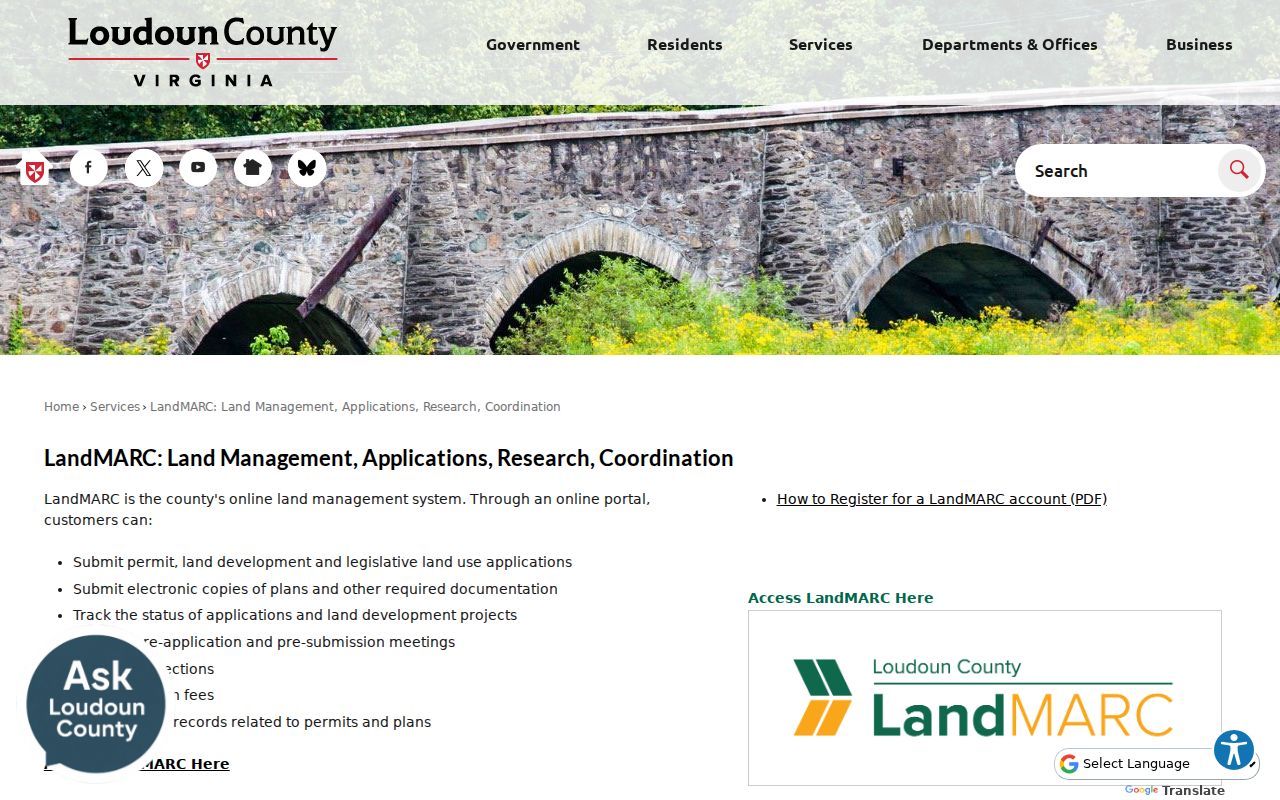
A specific request that will not surface in the search has a documented fallback. Submit the county permit inquiry form when the portal result stays unclear.
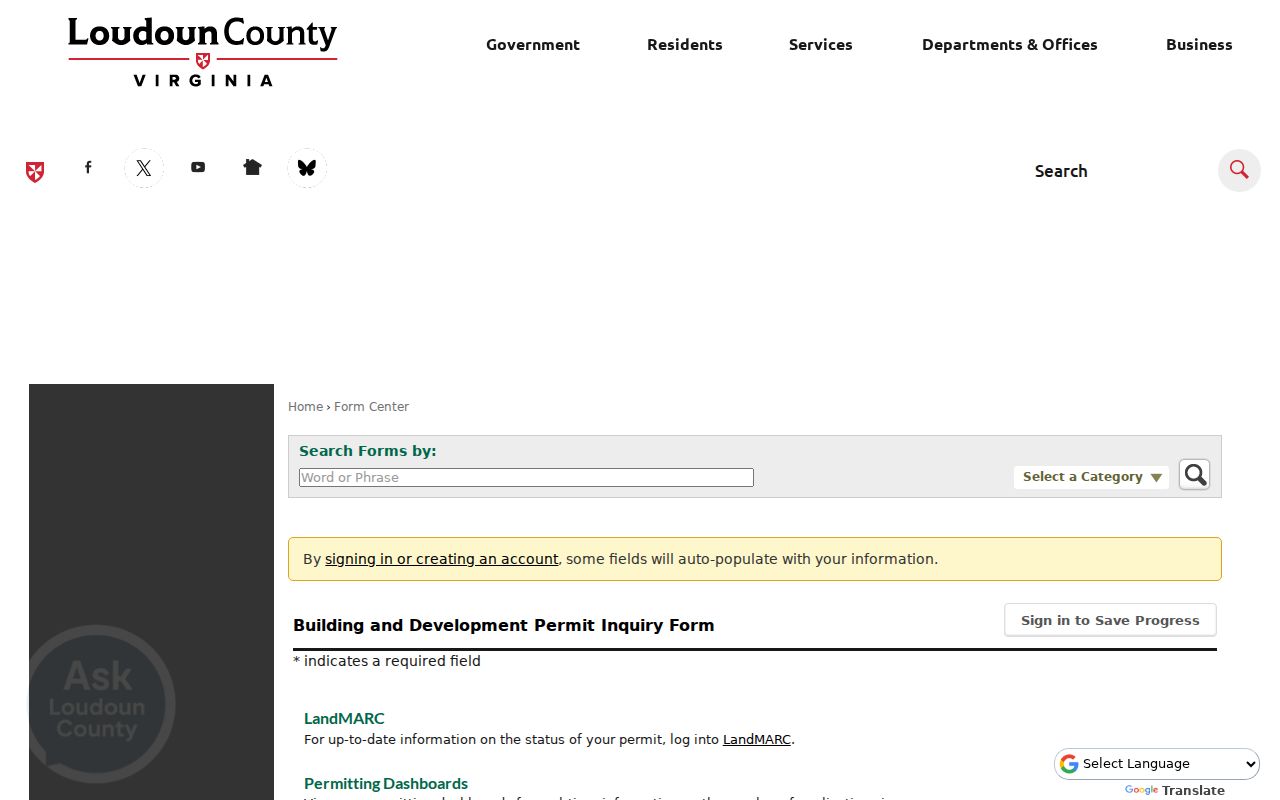
Keep the permit number and property address in the inquiry. A town-issued record stays with the issuing town, even when the county portal is the first stop.
Tax Sale Files Need a Deed Check
Loudoun's tax-sale page describes judicial sales of land for delinquent taxes under Virginia Code §58.1-3965. Sale properties run as ads in Loudoun Now for four straight weeks. Buyers must register and show funds for the minimum deposit. They must certify they own no Loudoun property with delinquent taxes. Zoning or other violations also disqualify them.
Each property sells as-is, and the county urges an independent title investigation. Owners can redeem before sale by paying taxes, penalties, interest, costs, and fees. Judicial sales need Circuit Court approval. Nonjudicial sales answer to the Treasurer. The purchaser pays recording costs and receives a special warranty deed.
For a distressed parcel, line up the sale notice, the court case, and the Treasurer account. Then add any later special warranty deed. The Clerk holds excess proceeds. A tax-sale notice never replaces tracing title or reading the recorded conveyance.
House History in Loudoun County Libraries
Recorded deeds and plats pair well with local history sources. The question is how a house or tract changed over time. Loudoun County Public Library offers Ancestry Library Edition for branch use. It also offers HeritageQuest Online. Civil War Era newspapers run from 1840 through 1865, and a Washington Post archive spans 1851 through 2001.
Rust Library and the Law Library sit in Leesburg; Purcellville Library serves the western county. Ask staff about local newspapers. Ask too about historic directories, obituary indexes, census access, microfilm, Sanborn maps, and vertical files. The public pages name no exact city-directory titles or years. Treat a library search as a lead. Confirm property details in the Clerk's deed, plat, or assessment record.
The Library of Virginia offers state archival finding aids. A newspaper clipping or family record can identify a person or time period. The recorded instrument still proves the legal transfer.
Limits of Loudoun County Property Records
Public files answer many questions. They can show the owner of record, the tax roll, payment history, deed terms, permits, and parcel context on a GIS map. They will not tell you who lives somewhere. Keep the limits straight, too. An assessment is not a sale appraisal, and a GIS line is not a boundary survey. An index entry is not a title opinion either. For any real question, match the deed, plat, or custodian record that fits.
Timing adds its own wrinkles in Loudoun County. The assessor refreshes its database weekly. WebLogis updates parcel boundaries and address points daily, drawn from the prior business day. The Clerk's index moves only when instruments are recorded. A recent transfer or parcel split can therefore show up differently across these systems. Loudoun advises extra care with parcels divided or combined in the previous 36 months. Town-line units such as -001 and -002 can also stray from the GIS parent shape.
Searching for an instrument works best in steps. Start with the current grantee and PIN, try spelling variants, then compare the legal description against the recording reference. The remote Clerk index splits its free basic index from paid document images. The free public kiosk and mailed copy routes cover different needs. Those choices help you locate a record. Each custodian still confirms what it holds.
Lawful use. Loudoun County records support property research, purchase due diligence, and civic review. Do not use owner information to stalk, harass, or harm anyone; use a title professional or licensed surveyor when the question needs a legal conclusion.